


We’ve all heard about someone falling for a scam of one kind or another. We hope we ourselves will be savvy enough to spot one if (when!) we become the target. But scammers keep trying to outsmart us, and even the most diligent of us can fall prey.
I get scam emails regularly, spot them with ease and delete them. But whether my guard was down, or this one was just worded better, I found myself responding to one.
The email looked like it was from one of my employees, let’s say her name was “Lisa Martin”. She was letting me know she wanted to update her direct deposit bank information. I’m hurrying through my emails and respond, “Sure, happy to do that. Just give me a call and we’ll get it done.” I hit send and went on my merry way. Later, it hit me. Was that email really from Lisa?
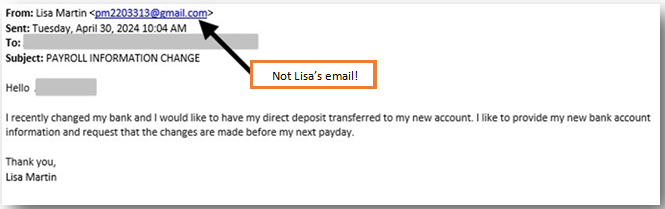
Sure enough, when I went back to the email and hovered over Lisa Martin as the sender’s display name, the email that showed was actually a random Gmail email address. Definitely not from Lisa. This is called spoofing and is done frequently by scammers. Crisis averted. This time! It was a good reminder to always hover over and check the sender’s display name to make sure it is their legitimate email, before responding or engaging with that email.

Source: Federal Trade Commission’s “A Scammy Snapshot of 2023”
While email scams are quite frequent, even daily, it is not the only way scammers reach their targets. And aging Americans are frequently targets – some say because we are less savvy and more gullible. Or are we targeted because we have more resources at our disposal? Perhaps a combination of these things. Regardless, individuals over 60 account for the highest number of cybercrime victims in the US. Here are some of the more common scams we should all be on the watch for.
Be on Your Guard for These Top Scams
Grandparent or Family Scams: Whether it is someone pretending to be a grandchild or a “police officer” contacting you about an incident affecting a grandchild, this one involves the plea for help from someone you love and enlisting your help to protect them from the wrath of a parent. My mother-in-law has received a call twice from her “grandson”. Twice! Shows you how common this one can be. When asked what his dog’s name was, the line went silent. Gotcha!
Government Imposter Scams: Scammers pretend to be a government official, claiming to offer financial assistance or threatening legal action. Whether it is from the Social Security Administration, Medicare, the IRS or some other official entity, be suspicious of any call from a government agency asking for money or information. Government agencies don’t call with threats or promises of – or demands for – money. Scammers do.
Here are a few tips from the FTC:
- Don’t trust caller ID – it can be faked.
- Never pay with a gift card or wire transfer.
- Check with the real agency. Look up their number. Call them to find out if they’re trying to reach you – and why.
Elder Financial Abuse: This encompasses a variety of scams, from tech support representatives claiming a problem with victim’s computer or software, online shopping scams involving fake online stores or deceptive offers, fake sweepstakes and lotteries offering “prize winnings” that require upfront fees or taxes to claim, cryptocurrency or false investment schemes with promises of high returns on investments, reverse mortgage scams with fraudulent offers related to home equity, or funeral scams exploiting grieving families by overcharging for funeral services or selling unnecessary products.
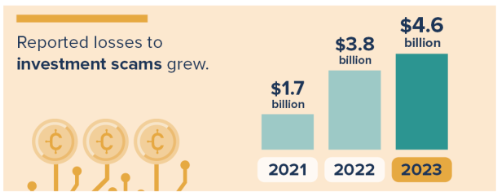 Source: Federal Trade Commission’s “A Scammy Snapshot of 2023”
Romance Scams: Widely known as “catfishing”, romance scams are on the rise and rank number one on total reported losses by the FTC. Fraudsters create fake identities to lure someone into a relationship which results at some point in a request for money, gifts or in more recent years, the sharing of a wonderful “investment” opportunity in cryptocurrency. These scams can originate from dating websites or from a simple text message that appears to be an innocent “wrong number” but then they start trying to engage in further conversation. These scammers are often armed with psychological warfare – knowing how to gain trust and emotional attachment to the point that the victim becomes so invested in the relationship that they don’t see the forest for the trees.
How to Report a Scam
Scams often go unreported, and even when they are reported, it is extremely difficult to trace and catch scammers. Estimates show only about 5% of cybercriminals are caught. Regardless, it is still critical to tell others and report a scam. When you report a scam, authorities can use the information to build cases against scammers, spot trends, educate the public, and share data about what is happening.
If you experience a scam — or even spot one, report it to the FTC at ReportFraud.ftc.gov and/or the FBI’s Internet Crime Complaint Center (IC3). The Federal Trade Commission also provides a detailed list of what to do if you or a loved one paid a scammer, provided a scammer personal information, or the scammer has access to your computer or phone.
Bottom Line
Remember, proactive vigilance and awareness is your best defense. Stay informed and cautious to protect yourselves from scams. Keep up to date on scams by reading from credible sources like the Federal Trade Commission, Consumer Financial Protection Bureau or nonprofit organizations like AARP.
For more information on these and other various scams, visit these sites: ConsumerFinance.gov, Consumer.ftc.gov/scams, or the AARP Fraud Watch Network.
:format(webp):quality(80)/u.realgeeks.media/floridaplusrealty/schedule6.png)