If rising insurance costs have made you nervous about buying or selling in Florida, there's a piece of data worth knowing about. Florida's property insurance market is showing real signs of stabilizing, and that could mean more coverage options and fewer headaches at the closing table.
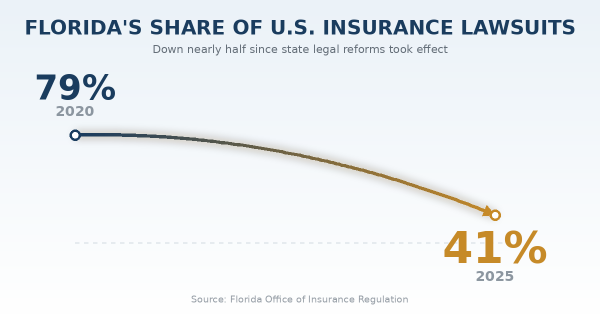
New numbers show Florida's outsized share of the nation's homeowners insurance lawsuits has dropped significantly since the state overhauled its claims litigation rules.
Here's the trend and what it means to Florida homeowner's and potential buyers.
The Numbers Tell the Story
According to the Florida Office of Insurance Regulation, the state made up roughly 5% of homeowners insurance claims nationwide in 2025, yet accounted for about 41% of the lawsuits tied to those claims. That's a big gap, and it's still disproportionate. But here's the encouraging part: that lawsuit share is nearly half of what it was back in 2020, when Florida represented about 9% of claims nationally but generated more than 79% of the country's insurance lawsuits.
The financial picture backs this up. Florida-domiciled insurance carriers went from nearly $1.5 billion in total underwriting losses in 2020 to more than $1.7 billion in gains in 2025, roughly a 180% turnaround in under five years.
In other words, the trend line is moving in the right direction, and it's moving fast.
What Changed
This didn't happen by accident. Florida lawmakers passed insurance reforms in 2022 and 2023 aimed at curbing the litigation that had been driving costs up for years. Those reforms limited attorney fees in property insurance lawsuits and put a stop to the practice of homeowners signing over their insurance benefits directly to contractors, a practice that had fueled a lot of the legal disputes.
Lisa Miller, former Florida deputy insurance commissioner, explained the impact of one change in particular:
"The legislative reforms, among other things, eliminated the guaranteed one-way attorney fees for plaintiffs that provided a gross incentive to sue, with fees in some cases that were five or six times greater than the claim amount itself."
The result: at least 20 new insurance carriers have entered the Florida market since the reforms took effect, and several companies already writing policies here have announced rate decreases.
What This Means If You're Buying or Selling
A more stable, more competitive insurance market doesn't mean your premium is about to drop overnight. Costs still vary widely depending on the property, its location, the insurer, and the level of risk involved. A home near the coast will always look different on paper than one further inland.
But a healthier carrier market makes a real difference in a few practical ways:
- More options to compare. With more carriers competing for business, buyers have a better shot at finding coverage that fits their budget instead of settling for whatever's available.
- Fewer closing surprises. Insurance issues are one of the most common last-minute snags in a Florida closing. A more predictable market means fewer scrambles to secure a policy before the deadline.
- Easier mortgage approval. Lenders typically require proof of adequate insurance before they'll fund a loan. More competition among carriers can make that step smoother.
Here's What We're Seeing in Our Central Florida Market
For our 55+ buyers and sellers, this is especially good news. Insurance costs have been one of the top concerns we hear from people relocating to Florida, right alongside questions about the upcoming homestead tax vote. A more stable insurance market removes one more obstacle standing between "thinking about it" and "making the move."
Central Florida also has a built-in advantage that's worth pointing out to buyers weighing where to settle. Being roughly 40 to 45 miles inland puts our area in a lower wind-risk tier than coastal communities, since hurricane wind speeds drop off considerably once a storm moves off the water. Add to that our relatively high elevation, which keeps most homes out of the costly flood zones common along the coast, and a claims history that's historically been lighter than the Gulf Coast or South Florida, and it's no surprise that homeowners here often pay well below the statewide average. It's not that we're immune to storms, but the risk profile inland is simply different, and insurers price it that way.
We're already fielding fewer insurance-related delays at the closing table than we were a couple of years ago, and that trend tracks with what the statewide data is showing.
Bottom Line
Florida's insurance market isn't fixed overnight, and costs will still depend heavily on your specific property. But the direction of travel is encouraging, and it's one more reason buyers who've been sitting on the sidelines might want to take a closer look now.
If you'd like help understanding what insurance might look like for a specific property, or want to talk through your options for buying or selling in our area, let's connect.
